Why This Works Without Smell
Miso is one of the most powerful umami sources available to a cook. It's the product of months — sometimes years — of fermentation, and that process concentrates glutamates: the compounds responsible for the savoury depth we experience as umami. Crucially, umami is felt on the palate rather than smelled in the nose. It registers as a coating richness, a persistent weight on the tongue that doesn't vanish when you exhale.
When you have anosmia, you lose access to the aromatic complexity that makes cooking rewarding for most people. But umami doesn't need aroma. Neither does salt. Neither does sweetness. Neither does the sharp edge of rice vinegar cutting through fat.
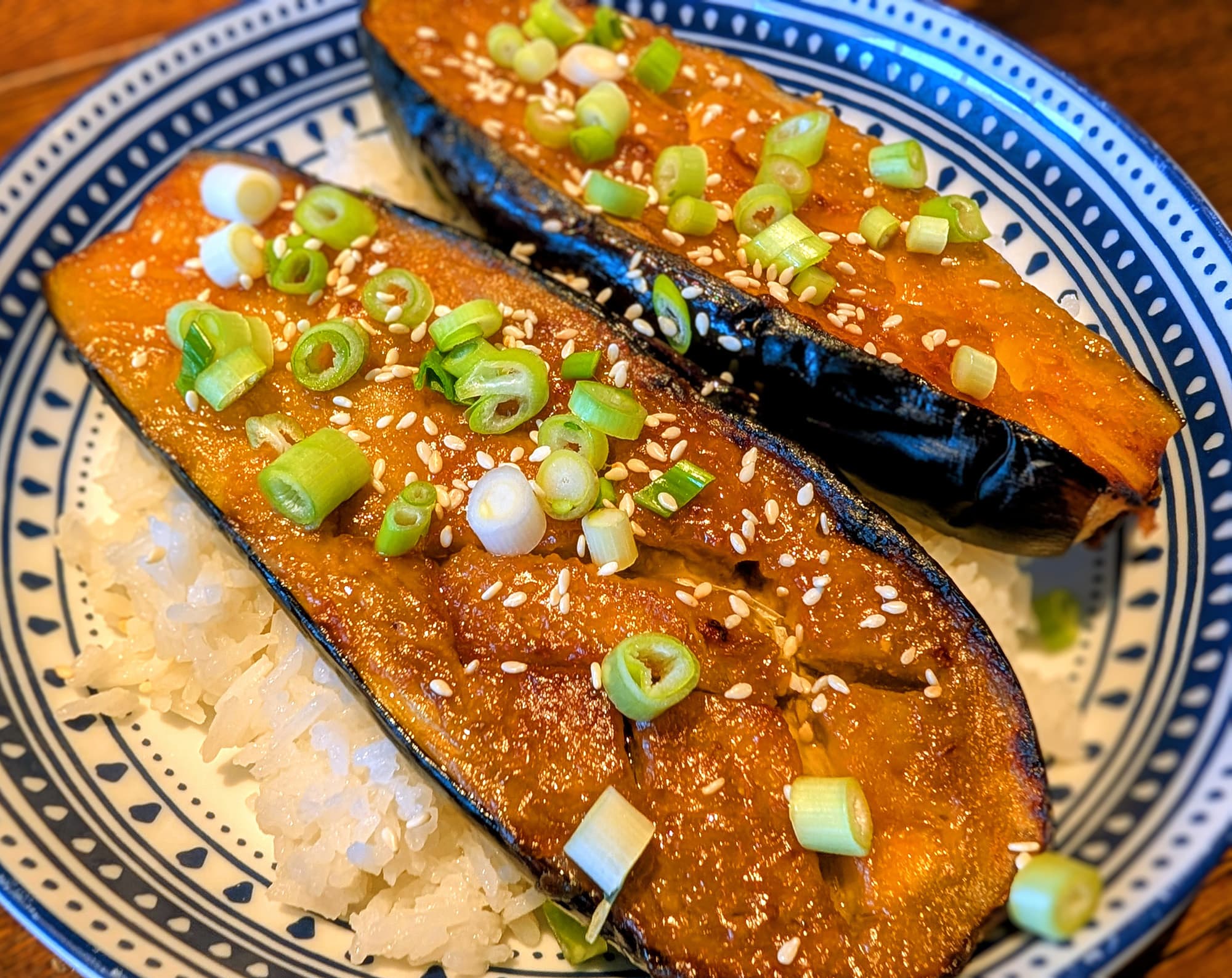
The aubergine is critical here. Roasted at high heat until caramelised, it develops a silky, yielding texture — almost custard-like at the centre — that contrasts beautifully with the lacquered, sticky glaze on the surface. That contrast between soft interior and glazed exterior is something you can experience completely, without any sense of smell whatsoever.
Ingredients
- 2 medium aubergines (about 600g total)
- 3 tbsp white (shiro) miso paste
- 2 tbsp mirin
- 1 tbsp rice vinegar
- 1 tbsp sesame oil
- 1 tsp caster sugar
- 2 tbsp neutral oil (sunflower or vegetable), for brushing
- Spring onions, thinly sliced, to garnish
- Sesame seeds, to garnish
Method
1. Prep the aubergine
Preheat your oven to 220°C (200°C fan) / 430°F. Line a large baking tray with baking parchment.
Halve the aubergines lengthways. Using a sharp knife, score the cut flesh in a deep crosshatch pattern — cut down about 2cm into the flesh, spacing cuts roughly 1.5cm apart. Be careful not to pierce the skin. This scoring does two things: it dramatically increases the surface area available for caramelisation, and it lets the glaze penetrate into the flesh rather than sitting only on the surface.
Brush the scored flesh generously with neutral oil — use more than you think you need. Place the halves cut-side down on the prepared tray.
Roast for 15 minutes until the flesh has softened and the skin has started to blister and collapse slightly.
2. Make the glaze
While the aubergine roasts, whisk together the miso paste, mirin, rice vinegar, sesame oil, and sugar in a small bowl until completely smooth. The mixture should be a glossy, dark paste — thick enough to coat a spoon but loose enough to spread.
A note for people with reduced taste sensitivity: taste the glaze carefully before using it. It should register clearly as: salt first, then sweetness from the mirin, then a brief sharp note from the vinegar. The sesame oil adds a persistent background richness. If your salt perception is reduced, add a small pinch of fine sea salt and taste again. The glaze should feel almost aggressively savoury — it will mellow considerably when it hits the heat and caramelises.
3. Glaze and return to the oven
Flip the aubergine halves cut-side up. Spoon or brush the miso glaze generously over the scored flesh, working it into the cuts with a pastry brush or the back of a spoon. Use all of the glaze — it will seem like a lot, but a significant portion will caramelise away.
Return to the oven for a further 10–12 minutes. Watch carefully from the 8-minute mark. The glaze should be deeply caramelised, darker at the edges and slightly charred in patches. That char is not a mistake — it's where the most intense flavour concentrates.
4. Finish and serve
Remove from the oven and leave to rest for 2 minutes (the flesh continues cooking off the heat). Scatter generously with sliced spring onions and sesame seeds.
Serve immediately while the textural contrast between the caramelised exterior and the silky interior is at its most vivid. Serve alongside steamed short-grain rice to carry the glaze, or with cucumber ribbons dressed in rice vinegar and a pinch of sugar.
Tips
On miso selection: White miso (shiro miso) is sweeter and milder than red (aka) miso. For a more intensely savoury result, substitute half the white miso with red miso. The flavour difference is significant — white miso reads as sweet-savoury, red miso as deeply fermented and pungent on the tongue. Both versions work without smell.
On scoring depth: The crosshatch pattern is not optional — it determines how much surface area you create for caramelisation and how deeply the glaze penetrates. Shallow cuts result in a surface coating that slides off; deep cuts give you glaze woven into the flesh. Err on the side of deeper.
On timing: The second roasting stage (after glazing) requires attention. Miso sugar burns quickly. Check at 8 minutes: you want caramelised and slightly charred at edges, not uniformly black. If your oven runs hot, pull at 8 minutes.
Making it a full meal: Add a soft-boiled egg (6 minutes, cold water shock) and some blanched tenderstem broccoli. The egg yolk combines with residual glaze to create a rich sauce when broken. The broccoli adds textural variety and a mild, pleasant bitterness that balances the sweetness of the mirin.
Storage: The glazed aubergine keeps in the fridge for up to 2 days. Reheat in a hot oven (200°C) for 5–6 minutes rather than microwaving — the microwave turns the texture to mush.